
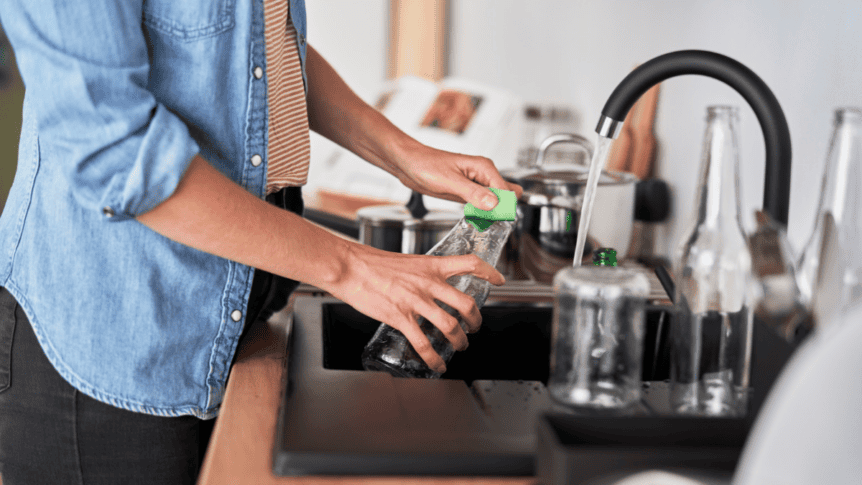
We’ve all been there: standing over the kitchen sink, staring at a nearly empty yoghurt pot or margarine tub, wondering, “Is this actually clean enough to recycle?”.
Because everyone’s idea of “clean” is different, it’s easy to get confused. Here is why cleaning your recycling matters, how much effort you really need to put in, and what to do with everyday household items.
Why dirty items ruin everyone’s efforts
Leftover food and liquid in your recycling bin cause a bigger problem than you might realise. Once your bin is emptied into the collection lorry alongside your neighbours’ waste, the whole load is taken to a depot and visually inspected.
If the load contains too much food or dirt, the entire lorry-load is rejected. That means tonnes of good, clean recycling gets ruined by a few dirty containers. Instead of being recycled, the whole batch is sent to an energy-from-waste facility, which is worse for the environment and much more expensive for your local council.
The two golden rules of clean recycling
You don’t need to spend your evenings scrubbing jam jars until they sparkle, and you don’t need to waste loads of hot water. Just stick to two simple rules:
- Empty all liquids
- Remove all food
A quick rinse under the cold tap or a dunk in your leftover washing-up water is usually all it takes.
How to prep common items for the bin
Empty completely (do not pierce or crush)
- Aerosol cans (deodorant, hairspray, polish)
Empty completely and give a quick rinse
- Cartons (juice and milk, such as Tetra Pak)
- Drinks cans
- Glass bottles (beer, wine, sauces)
- Plastic bottles (squashing them afterwards saves space in your bin)
Squeeze until empty (a tiny bit of residue is fine)
- Cosmetic tubes
- Toothpaste tubes
Shake off crumbs (bin it if it’s greasy)
- Kitchen foil (scrunch clean foil into a ball; if it’s covered in grease or food, put it in your rubbish bin)
Rinse or dunk in old washing-up water
If stubborn, baked-on food won’t budge, put the item in your rubbish bin instead.
- Foil takeaway trays
- Glass jars (jam, peanut butter, pasta sauce)
- Metal food tins (watch out for sharp edges!)
- Plastic takeaway trays
- Plastic plant pots (Note: only non-black plastic pots can be recycled; black plastic pots must go in the rubbish bin)
- Plastic pots, such as yoghurt and cream pots
- Plastic tubs, such as margarine and soup tubs
Special rules: Pizza boxes, paper, and card
What you do with paper and cardboard depends on where you live in Surrey, especially if you live in Reigate and Banstead, which collects paper and card separately from mixed recycling, and Spelthorne.
Reigate and Banstead:
- Pizza boxes with food on – put in your rubbish bin
- All other pizza boxes – put in your paper and card recycling container
- Wet paper and card – put in your paper and card recycling container
Spelthorne:
- Shop-bought pizza boxes with no grease or food on – put in your mixed recycling bin
- All other pizza boxes – put in your rubbish bin
- Wet paper and card – put in your rubbish bin
The rest of Surrey:
- Pizza boxes with no grease or food on – put in your mixed recycling bin
- All other pizza boxes – put in your rubbish bin
- Wet paper and card – put in your rubbish bin
For more information, visit our page on how to recycle right. And to check what to do with almost any item you can think of, including what to do with it before it goes into the bin, use the Surrey Recycles search tool.
Take the Surrey Recycling Challenge today!